Age-Appropriate Bedtime Stories by Age: A Guide for Ages 1–8
Short answer: An age-appropriate bedtime story is short and repetitive at 1–2, adds imagination and feelings at 3–4, and can carry a clear 5–10 minute plot by 5–6. CDC notes that most 5-year-olds can pay attention for 5 to 10 minutes during story time (CDC). By 7–8, many children can follow a chapter of a longer book. At any age, a calm ending matters more than a long one.
Why age-appropriate bedtime stories matter
A bedtime story that is too long fights a tired brain. A story that is too abstract loses a young one. Matching the story to your child's age is not about picking a "smarter" book — it is about matching the story's length, language, and emotional tone to how their attention and understanding actually work at that stage.
Three things make age-appropriate stories work. First, predictability: a child who knows roughly what is coming relaxes into the ritual. Second, sleep association: the same calm, low-stimulation pattern each night teaches the brain that this sound means it is time to wind down. A research review lists reading and singing among the core parts of a bedtime routine and links routines to better sleep and early language and literacy (Mindell & Williamson, 2018). Third, attention: a story that fits their attention span ends before they lose interest, so the ending feels satisfying rather than exhausting.
You do not need a bigger book collection. You need a better match between the story and the child in front of you tonight.
Quick reference: bedtime stories by age (1–8)
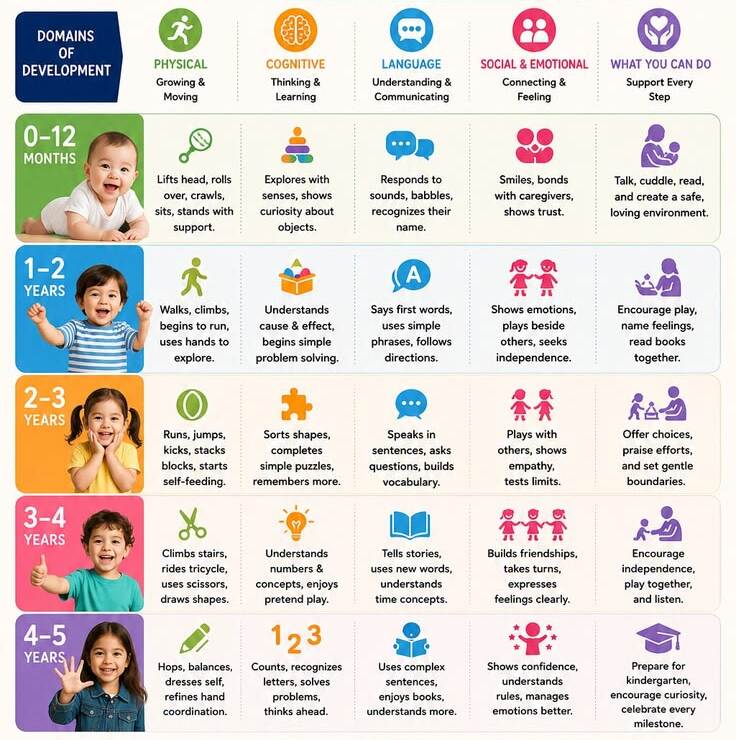
| Age | What most kids can do | One bedtime story* | Themes that settle well | Sleep per 24 h |
|---|---|---|---|---|
| 1–2 | By 2: points to things in a book when asked; puts two words together (CDC) | 1–5 min | Their name, daily routines, animal sounds, goodnight | 11–14 h incl. naps |
| 3–4 | Asks "who/what/where/why" (by 3); tells what comes next in a well-known story (by 4) (CDC 3, CDC 4) | 3–8 min | Toys that come alive, naming feelings, small friendships | 10–13 h incl. naps |
| 5–6 | By 5: pays attention 5–10 min during story time; retells a story with at least two events (CDC) | 3–10 min | Clear beginning-middle-end, light facts, starting school | 10–13 h at 5; 9–12 h at 6 |
| 7–8 | Enjoys chapter books read aloud and more complex plots (Reading Rockets; CCBC) | 10–15 min, or one chapter | Fairness, problem-solving, humor, "what would you do?" | 9–12 h |
*Story length is StoryRadio's practical guidance for one bedtime story, not a scientific benchmark. Every child is different. Milestones are things most children (75% or more) can do by that age (CDC). Sleep ranges are from the American Academy of Sleep Medicine consensus, endorsed by the American Academy of Pediatrics (AASM).
Ages 1–2: rhythm, repetition, your voice
By age 1, most babies play games like pat-a-cake, wave "bye-bye" and understand "no". By age 2, most point to things in a book when you ask and put two words together, like "more milk" (CDC, 1 year; CDC, 2 years). CDC's bedtime tip for 2-year-olds is simple: pajamas, teeth, and 1 or 2 books.
Age 1, tonight:
keep it brief and lullaby-like, 1–3 minutes. Repeat your child's name, use familiar sounds, keep a gentle rhythm. The goal is warmth and calm, not plot.
Age 2, tonight:
a 2–5 minute story about everyday routines (bath, bedtime, favorite objects) with a gentle goodnight ending. "Read it again" is a feature: the same story for several nights is fine.
Ages 3–4: imagination, feelings, friends
By 3, most children ask "who," "what," "where" or "why" questions and can say what is happening in a picture or book. By 4, most can tell what comes next in a well-known story and pretend to be someone else in play (CDC, 3 years; CDC, 4 years). This is also when fear of being alone and of the dark often starts (Raising Children Network). If that's your evening, see our bedtime routine for fear of the dark.
Age 3, tonight:
bring a favorite toy to life in a cozy 3–6 minute adventure. Name feelings along the way ("Bear feels nervous, then brave") and end warm and safe. Cozy, not thrilling. Example: if your child keeps asking about the moon, tonight's story can make the moon a shy friend who only comes out when the house is quiet, ending with a whispered "goodnight, Moon."
Age 4, tonight:
5–8 minutes with two or three friends who share and solve a small problem together. Kindness and gentle courage work well. CDC suggests asking a 4-year-old what they think might happen next (CDC).
Ages 5–6: clear plots, curious questions
By 5, most children can tell a story they heard or made up with at least two events, answer simple questions about a story, and pay attention for 5 to 10 minutes during activities like story time (CDC, 5 years). That 5–10 minute window is a sensible ceiling for one bedtime story. Kindergarteners also enjoy stories that show how characters treat each other (Reading Rockets).
Age 5, tonight:
one 3–8 minute story with a clear beginning, middle and end, with a light fact woven in (why the moon changes shape). Short on time? A familiar picture book you can read in 3–5 minutes works just as well.
Age 6, tonight:
up to about 10 minutes, or one short chapter, about new beginnings, change or confidence, since many 6-year-olds are adjusting to school. End with an optional question: "What would you do if you were the fox?"
Ages 7–8: longer plots, fairness, humor
CDC's milestone checklists stop at age 5, so for this band we lean on reading specialists. Reading Rockets suggests second and third graders enjoy characters "dealing with the same fears, interests, and concerns that they experience," chapter books read aloud above their own reading level, and books that lead to discussion (Reading Rockets). Readers around 7 to 10 can handle more complex storylines and stories told from more than one point of view (Canadian Children's Book Centre).
Age 7, tonight:
10–15 minutes, or one chapter, with a clear problem, logical problem-solving and a fair ending.
Age 8, tonight:
one chapter of a longer book, with humor, wordplay and gentle questions of right and wrong. Stop at a quiet point, not a cliffhanger. Looking for free options? See free bedtime stories for 8-year-olds.
Free bedtime stories for 8-year-olds
Eight-year-olds can follow longer plots, so free options go well beyond picture books:
- Your public library. With the Libby app and a library card, you can borrow free ebooks and digital audiobooks; loans download for offline use on Wi‑Fi (Libby help). One chapter a night of a read-aloud chapter book suits this age.
- A favorite you already own. Re-reading is fine. Reading Rockets notes second graders may want the same book many times (Reading Rockets).
- Free audio story sites. Sites such as Storynory offer free audio stories for kids. Preview a story first and pick a calm one for bedtime.
- StoryRadio. A free, ad-free, audio-only app for ages 1–8, in English; its personalized stories adapt to the age you set. The free tier plays at least 25 stories a day, and a sleep timer stops playback at the time you set. Trade-offs: there's no text to read along, and new stories need an internet connection (favorites play offline: 3 on free, up to 10 with Premium). Premium is live, but it can't be purchased yet; for now it's available only through official StoryRadio promotions — follow us on X (@jambingstudio) for details.
For a side-by-side look at free, ad-free apps, see our free bedtime story app guide and the bedtime story app chooser.
How to choose tonight (3 checkpoints)
Run these three quick checks before you pick:
- Can they sit through it without squirming? Match the length to the age table above.
- Is it calming or exciting? At bedtime, choose calm. Save the high-energy adventure for daytime.
- Is it the same order as last night? A predictable sequence matters more than a new story. When in doubt, repeat the same gentle order.
Screen-free audio bedtime
A story read aloud or played as audio helps a child close their eyes and listen, instead of watching a screen. Bright screens and fast-moving video stimulate the brain at the exact moment you want it to slow down.
For a book-first combo, see our read-aloud and audio bedtime stories guide.
If you use audio: put the phone down out of reach, use continuous playback so stories flow one into the next, and avoid the "one more video" negotiation. Set a sleep timer so playback stops on its own. For more ways to swap video for audio, see screen-free bedtime stories; to compare a phone with a dedicated player, see phone app vs. Yoto or Toniebox. A calm voice telling a story is a different experience from a screen — and for sleep, that difference matters.
How StoryRadio grows with your child
The table and ideas on this page work with any book or audio. No app required.
If you want a hands-free option, StoryRadio is a free, audio-only bedtime story app for ages 1–8, in English, with no ads on any tier and no device to buy. In Personalize mode, you set your child's age once and personalized stories adapt to it: short and repetitive for toddlers, richer and more social for older kids. Fables, Sleep and nightmare-rewrite stories are not split by age yet. They're narrated in a calm voice with continuous playback, like a vintage radio. The free tier plays at least 25 stories a day, with daily minimums of 10 Fables, 10 Sleep stories, 5 personalized stories and 2 nightmare-rewrite stories. A built-in sleep timer stops playback at the time you set. New stories need an internet connection; favorites download for offline listening (3 on free, up to 10 with Premium). Premium is live, but it can't be purchased yet; for now it's available only through official StoryRadio promotions — follow us on X (@jambingstudio) for details.
Use it only if it fits your routine. A good bedtime story is the one that helps your child wind down, whatever the source.
Frequently asked questions
How long should a bedtime story be by age?
As a rough guide for one story: about 1–5 minutes at ages 1–2, 3–8 minutes at 3–4, 3–10 minutes at 5–6, and 10–15 minutes (or one chapter) at 7–8. CDC notes most 5-year-olds can pay attention for 5 to 10 minutes during story time. Every child is different, so stop while the story still feels calm.
What bedtime story fits a 2-year-old vs a 6-year-old?
A 2-year-old needs a short, repetitive story (about 2–5 minutes) with everyday themes and a gentle goodnight ending. A 6-year-old can follow a richer story of up to about 10 minutes with clearer plots, change and confidence themes, and an optional open-ended question for parent-child discussion.
Why should bedtime stories change as kids grow?
Because attention, language, and emotional understanding develop in stages. A toddler needs repetition and safety; a preschooler needs imagination and feelings; an older child can handle plots, logic, and richer themes. Matching the story to the stage keeps bedtime calming and effective.
What's a good quick bedtime story for a 5-year-old?
Pick a calm story with a clear beginning, middle and end that takes under 10 minutes to read, since most 5-year-olds can pay attention for 5 to 10 minutes during story time (CDC). On rushed nights, a short, familiar picture book read in 3–5 minutes works well.
Where can I find free bedtime stories for an 8-year-old?
Try your public library (free ebooks and audiobooks with a library card through the Libby app), re-read a favorite chapter book, use free audio story sites, or try a free, ad-free audio app such as StoryRadio, which plays at least 25 stories a day on its free tier.
Related guides
Sources
- CDC — Developmental Milestones (index)
- CDC — Milestones by 1 year
- CDC — Milestones by 2 years
- CDC — Milestones by 3 years
- CDC — Milestones by 4 years
- CDC — Milestones by 5 years
- American Academy of Sleep Medicine — Recommended amount of sleep for pediatric populations (consensus, endorsed by the AAP)
- Mindell & Williamson 2018, Benefits of a bedtime routine in young children (PMC)
- Reading Rockets — How to Choose Read Aloud Books: Babies to Third Graders
- Canadian Children's Book Centre — How to Choose a Book by Age
- Raising Children Network — Anxiety in children and childhood fears
- Libby — Getting started
- StoryRadio — Help kids with bedtime nightmares using imagery rehearsal